Solar panel installation
What solar panel installation costs in Cyprus in 2026
What a solar panel installation in Cyprus costs per kWp, which components move the figure, and how to read a quote before signing it.
8 min read
Maria runs the data collection behind our solar pages. She checks installer registrations against the electrical contractor register, records quoted system prices, and tracks changes to the grant schemes as they are published.
Published
Grid-tied residential solar in Cyprus is quoted per installed kilowatt-peak, and the island range recorded here runs from €900 to €1,300 per kWp supplied and installed, with the median close to €1,080. On that arithmetic a 5 kWp array — a common size for a Cypriot family house — lands between roughly €4,500 and €6,500 before any grant is applied. What moves a quote inside that band is rarely the panel brand. It is roof access, mounting method, electrical protection and how much of the grid connection the installer has priced.
| Work | Indicative range | Midpoint | Published sources |
|---|---|---|---|
| Solar panel installationTurnkey grid-tied residential rooftop PV: modules, inverter, mounting, electrical work and the EAC grid-connection application. Excludes battery storage and any government grant. Small 3 kWp systems sit at the top of the range, 10 kWp systems at the bottom, because fixed costs are spread over more capacity. | €1,100–€2,000per kWp | €1,400 |
|
Indicative range compiled from published sources, not a quote. It shows the level those sources report for this kind of work, not what your job costs. Only a site visit and a written quote for your actual scope produce a real figure. Sources compiled 2026-08-02.
The short answer
The per-kWp figure is the only number that lets two quotes be compared, because it survives a change of system size. A quote written as a single total for "a solar system" cannot be checked against anything. The same total divided by the array size can be checked against the range above in about ten seconds.
The second number worth holding is yield. Cypriot roofs return in the region of 1,500 to 1,700 kWh per installed kWp per year, depending on orientation and shading, so a 5 kWp array produces something like 7,500 to 8,500 kWh annually. Price per kWp and yield per kWp together describe the whole transaction. A low price per kWp on a badly oriented roof plane is not a saving.
Grants change the net figure rather than the quoted one. The residential photovoltaic support scheme pays toward a grid-connected system on a primary residence, is means tested, and has to be applied for before installation begins — a sequencing point that catches out more households than the means test does.
Scheme terms move, so the box above is read from the records at page load with the date each entry was last checked, rather than written into the text.
What drives the range
Five variables account for most of the distance between the bottom and the top of the band.
Roof type and mounting method
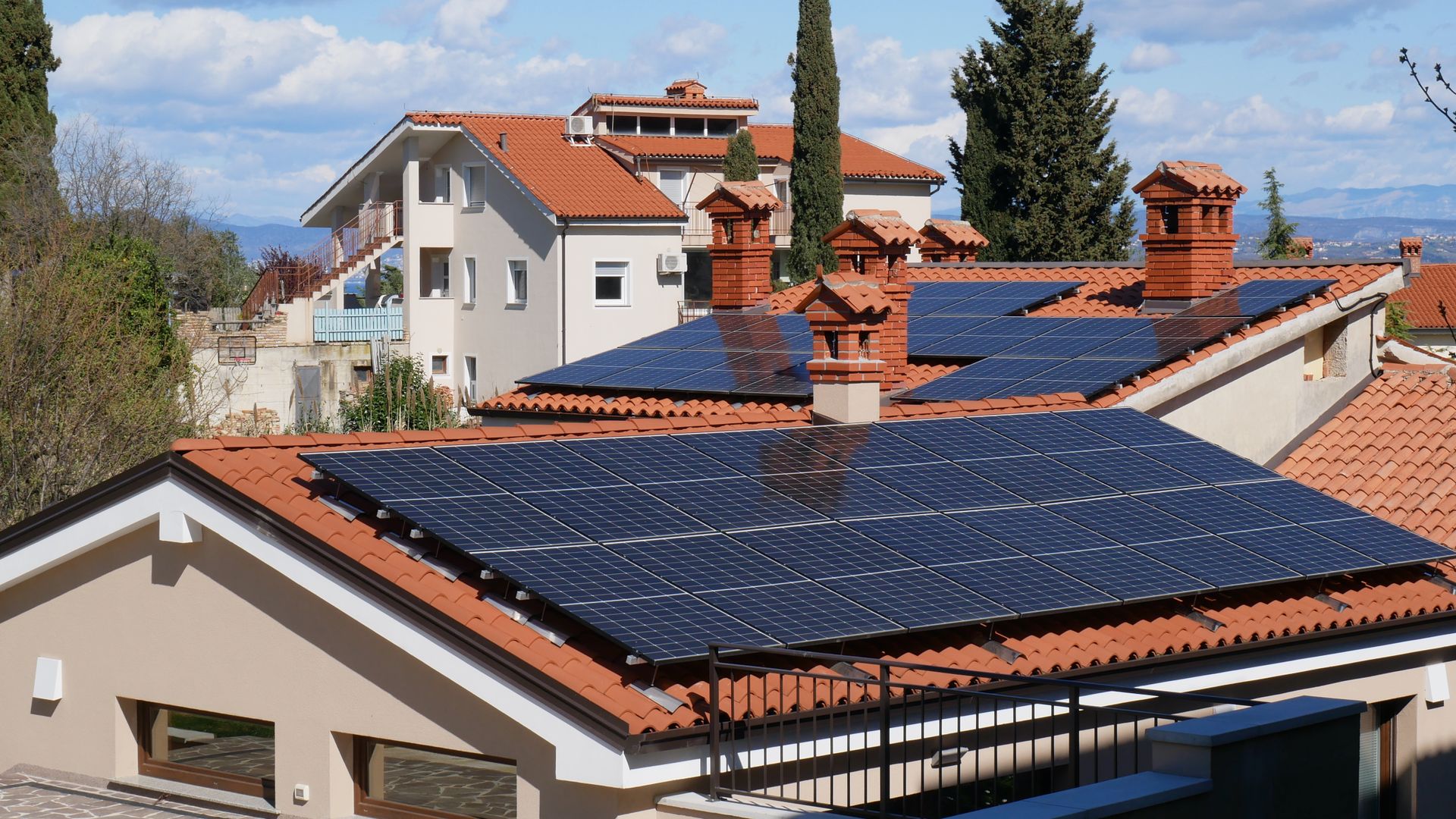
A single-storey flat concrete roof is the least expensive case: ballasted or lightly fixed frames, a short cable run, no working at height beyond a ladder. A pitched tile roof means lifting and reinstating tiles and fixing through to the structure, which is slower work at a higher hourly rate. A third-floor flat adds a long DC cable run down a riser and, in most blocks, written consent from the management committee before anyone starts.
Inverter choice and shading
A basic string inverter is the least expensive option and the least tolerant of shade — one panel darkened by a chimney, a water tank or a neighbouring block can drag down the whole string. Optimisers or microinverters cost more per kWp and isolate that loss. On an unshaded flat roof in Latsia the simple option is the correct one. On a Limassol roof overlooked by a taller block it is not, and a quote that ignores the difference is quoting a different outcome, not a lower price.
Fixings and corrosion class
On directly exposed coastal roofs — Kato Paphos is the clearest example — salt-laden air makes galvanised and marine-grade fixings standard rather than optional. Ordinary fixings are less expensive on the day and a callout within a few years. The specification should name the material, not just say "mounting system".
Waterproofing reinstatement
Almost every Cypriot flat roof carries a waterproofing membrane, often a recent one. Every mounting penetration is a potential leak, and reinstating the membrane properly around each foot is skilled work priced by the hour. A quote silent on reinstatement has either absorbed the cost or is not planning to do it.
Electrical protection and the existing board
DC isolators, AC isolation, surge protection and earthing are separate line items, and the first things to disappear from a thin quote. Older consumer units frequently need upgrading before a system can be connected at all — a real cost that belongs in the quote rather than in a conversation on the day.
There is also the roof furniture nobody mentions at the survey. Most older Cypriot houses already carry a thermosiphon solar water cylinder, whose tank throws a long, moving shadow and eats usable roof area. Whether it moves, stays or is replaced is a scope question with a price attached.
Cost by district
District differences in Cyprus are real, but they are differences in access, travel time and contractor density rather than in the price of hardware. Panels cost the same in Polis Chrysochous as in Nicosia; getting a crew and a delivery lorry there does not.
Nicosia. The largest inland market and the deepest pool of installers, which keeps day rates competitive. Strovolos and the surrounding suburbs hold a large stock of 1970s to 1990s apartment blocks, where the constraint is not the roof but the route from roof to meter and the state of the existing electrical installation. Flat-roofed single-storey housing in Latsia, Geri and Tseri is close to the ideal installation case.
Limassol. The most active construction market on the island, so installer diaries are tighter and rates follow. Rapid high-rise development has changed the shading picture in the centre: an array that is unshaded at survey can be overlooked by the time the next block beside it tops out, which is a reason to ask what the neighbouring plots are consented for. In Germasogeia, dense tourist-area grid connections mean export applications often require a load assessment before approval, which adds calendar time rather than euros.
Larnaca. Middling on rate and straightforward on access across Aradippou, Livadia and Oroklini. The salt lake raises local humidity around Oroklini, which matters more for enclosure and earthing corrosion than for the panels themselves.
Paphos. Two different markets in one district. Coastal Kato Paphos and Chloraka carry the salt exposure described above. The hillside plots above Peyia are the access problem in its purest form: steep and narrow roads limit the size of crane and delivery vehicle that can reach the site at all, which changes the method rather than adding a fee. Polis Chrysochous sits far enough from the main contractor base in Paphos town that travel time is carried on every day of the installation, not once.
Famagusta district. Paralimni, Ayia Napa and Protaras are dominated by seasonal tourist accommodation, so contractor capacity concentrates in the November to March window when the properties are empty. A domestic installation booked for July competes with refurbishment schedules and holiday-let availability at the same time.
The district pages carry the island-wide published range alongside the island range, and the areas index sets out which towns sit inside which district market.
What is usually excluded
The gap between two quotes is often not a discount. It is a shorter scope. These items are routinely left out and routinely appear later:
- Scaffolding or an access platform, where the roof cannot be worked safely from a ladder.
- Waterproofing reinstatement around mounting feet and cable entries.
- Consumer unit upgrade or replacement, common on installations predating the current wiring standard.
- Surge protection and earthing to the array, quoted separately from the inverter.
- The grid connection application to the Electricity Authority of Cyprus, including the export meter change. The application is submitted before commissioning and typically takes around 45 days, so it sets the date the system starts earning rather than the date the panels go up.
- Management committee consent for apartment and complex roofs, plus any common-area making good.
- Removal or relocation of an existing solar water cylinder, television aerial or satellite dish.
- Cable runs beyond a stated length, which is why the quote should state the length it assumed.
- VAT treatment. The standard rate is 19 per cent, with a reduced 5 per cent rate available on certain qualifying work at a primary residence. Whether a particular installation qualifies is a question for the Tax Department, and a quote should say plainly which rate it has used and whether the figure shown includes it.
How to compare quotes
Comparison only works when every installer has priced the same written scope. Without that, the exercise compares assumptions, and the lowest number is usually the one that assumed least.
Then run four checks. Divide the total by the array size and compare it to the range above. Confirm the yield figure is stated for the actual roof rather than for a flat theoretical plane. Check whether the grant application sits with the installer or the household, since it must be lodged before work starts. Finally, ask what is not included — the answer to that question separates two quotes faster than any other.
The solar installation guide on this site sets out the published ranges by system size, the services index lists the other trades that commonly appear on the same project, and the price index explains how each range was collected and how many quotes sit behind it.
Common questions
Is a larger system less expensive per kWp?
Usually, yes, because the fixed costs — survey, scaffolding, the grid connection application, the electrician's day — are spread across more panels. The saving flattens quickly, and past a certain point the constraint stops being price and becomes roof area, export approval and how much of the generation the household actually uses during daylight.
Does the €900 to €1,300 range include the grant?
No. The published range is the installed price before any grant. The residential support scheme pays toward a grid-connected system on a primary residence, is means tested, and must be applied for before installation begins, so it reduces the net outlay rather than the quoted figure.
Why do coastal quotes come in higher?
Because the specification is different. Marine-grade and galvanised fixings, better-sealed enclosures and more careful earthing are standard on directly exposed coastal roofs such as those in Kato Paphos. A seafront quote written to an inland specification is not a lower price for the same thing.
How long does the whole process take?
The physical installation on a straightforward domestic roof is a matter of days. The grid connection application to the Electricity Authority of Cyprus typically takes around 45 days and is submitted before commissioning, so the calendar is set by the paperwork, not by the crew.
Is a price per square metre a useful comparison for solar?
No. Panel efficiency varies, so the same square metre of roof can carry noticeably different capacity. Price per installed kWp is the unit the market quotes in and the only one that compares like with like.
Solar installers listed in Cyprus
8 companies shown here.
Limassol Electrician 24/7
Germasogeia, Limassol
Limassol Electrician 24/7 is an electrical contractor in Germasogeia, in the Limassol district. Recorded services include fault finding, consumer units, rewiring.
- Electrical work
- Solar panel installation
- Rewiring
- Solar panel maintenance
- +3 more
Vascon Solar Experts LTD
Dali, Nicosia
Vascon Solar Experts LTD is an energy supplier in Dali, in the Nicosia district.
- Solar panel installation
- Battery storage
- Solar panel maintenance
Kyriakos Louka & Yioi LTD (Office)
Strovolos, Nicosia
Kyriakos Louka & Yioi LTD (Office) is an electrical contractor in Strovolos, in the Nicosia district. Recorded services include fault finding, consumer units, rewiring.
- Electrical work
- Solar panel installation
- Rewiring
- Solar panel maintenance
- +3 more
- 1
KHALIL ABUSHALHA
Larnaca Centre, Larnaca
KHALIL ABUSHALHA is listed on the Cyprus Energy Service register of certified solar PV installers under registration ΕΦΒ/305/2024, valid to 2030-01-12. The entry covers ΛΑΡΝΑΚΑ, the larnaca district. Details come from the public register and have not been verified with the business.
- Solar panel installation
- Solar panel maintenance
- Commercial solar
MARK STUART DAVIES
Paphos Centre, Paphos
MARK STUART DAVIES is listed on the Cyprus Energy Service register of certified solar PV installers under registration ΕΦΒ/71/2020. That registration ran to 2026-02-27 and is not current in the register we hold. The entry covers ΠΑΦΟΣ, the paphos district. Details come from the public register and have not been verified with the business.
- Solar panel installation
- Solar panel maintenance
- Commercial solar
- 1
MOUSSA FAHER
Lakatamia, Nicosia
MOUSSA FAHER is listed on the Cyprus Energy Service register of certified solar PV installers under registration ΕΦΒ/424/2026, valid to 2032-03-04. The entry covers ΛΑΚΑΤΑΜΙΑ, the nicosia district. Details come from the public register and have not been verified with the business.
- Solar panel installation
- Solar panel maintenance
- Commercial solar
- 1
PATRICK MICHAEL MC CLUSKEY
Strovolos, Nicosia
PATRICK MICHAEL MC CLUSKEY is listed on the Cyprus Energy Service register of certified solar PV installers under registration ΕΦΒ/338/2024, valid to 2030-06-21. The entry covers ΣΤΡΟΒΟΛΟΣ, the nicosia district. Details come from the public register and have not been verified with the business.
- Solar panel installation
- Solar panel maintenance
- Commercial solar
STEVEN RUSH
Paralimni, Famagusta
STEVEN RUSH is listed on the Cyprus Energy Service register of certified solar PV installers under registration ΕΦΒ/64/2020. That registration ran to 2025-12-17 and is not current in the register we hold. The entry covers ΠΑΡΑΛΙΜΝΙ, the famagusta district. Details come from the public register and have not been verified with the business.
- Solar panel installation
- Solar panel maintenance
- Commercial solar
Sources
- Cyprus Energy Regulatory Authority — net metering framework — retrieved 2026-07-28
- Electricity Authority of Cyprus — connection and metering — retrieved 2026-07-28
- Ministry of Energy, Commerce and Industry — renewable energy support schemes — retrieved 2026-07-28
- Tax Department — VAT rates and reduced-rate work — retrieved 2026-07-28
01More on this topic
Same cluster.Different question.
 8 min read
Why Solar Panel Installation Prices Vary So Much in Cyprus
Why two Cyprus solar quotes for the same roof land far apart: panel and inverter choice, access, scaffolding and grid connection work.
 8 min read
Solar Panel Installation Quotes: What Should Be in Writing
Cyprus solar quotes run €900 to €1,300 per kWp installed. The eleven items a quote has to state, how payment stages work, and the wording to refuse.
Where to go next
Companies, districts and the rest of the guides on this subject.

Thinking of doing this?Get up to five quotes, free.
Send us the job and we will gather quotes against the same written scope, so the numbers are comparable.