Landscaping
What garden landscaping actually costs in Cyprus
Garden landscaping quotes in Cyprus are decided by slope, soil and irrigation. Here are the published ranges and what pushes a garden up them.
9 min read
Elena covers interior design, furniture and lighting for Cypriot homes. Her focus is the gap between a scheme drawn for a northern European climate and one that survives this light, this heat and, near the coast, this salt.
Published
A garden landscaping quote in Cyprus is two budgets wearing one total. There is the hard landscaping — levelling, retaining, drainage, paving, steps, walls — and the soft landscaping, which is soil, irrigation and planting. On most Cypriot plots the hard side is the larger of the two, because the ground slopes, because what the builder left behind is subsoil and rubble rather than topsoil, and because nothing planted here survives without water delivered to it deliberately.
The short answer
The bottom of that range is a level rear garden behind a newer detached house — the kind of stock that fills Aradippou and the newer edges of most towns — where the ground is already flat, the boundary walls already exist, and the scheme is gravel, a paved terrace, drip irrigation and drought-tolerant planting.
The top of the range is a sloping plot that has to be terraced before anything can be planted on it: retaining walls with drainage behind them, steps, imported topsoil, a pumped or gravity-fed irrigation system split into zones, and specimen trees craned over a wall because the access road will not take a delivery lorry. Those two jobs share a name and nothing else, which is why quotes for the same address can look implausible next to each other.
The figure that actually predicts the cost is not garden area. It is the volume of material that has to move — soil out, soil in, rock broken, block laid — before a single plant goes into the ground.
What drives the range
Slope, and what it takes to hold it
Terracing is the most expensive thing an ordinary garden can require. Retaining walls need foundations, reinforcement, drainage behind them and somewhere for that drainage to go. Above a modest height they need structural design from an engineer registered with ETEK, and they fall under building permit control rather than being treated as garden works. A gently graded plot avoids all of it.
What is actually under the surface
Very few Cypriot plots hand over with usable topsoil. What is normally there is construction spoil over marl or havara hardpan, which a mini digger will not cut through without a breaker attachment. Two costs follow: hire and labour for breaking out, and imported topsoil to replace what was never there. Both are volumetric, both are invisible from the surface, and both are routinely underestimated in a first quote given over the phone.
Irrigation, and where the water comes from
Irrigation is not an optional upgrade on this island; it is the thing that decides whether the planting is still alive in September. Standard specification is zoned drip irrigation on an automatic controller, with separate zones for trees, shrubs, beds and any turf, because those four things want completely different volumes. What varies in price is the number of zones, the run lengths, whether a pump is needed to reach an upper terrace, and whether the garden is fed from the mains, a stored tank or a licensed borehole.
Planting choice and the size it arrives at
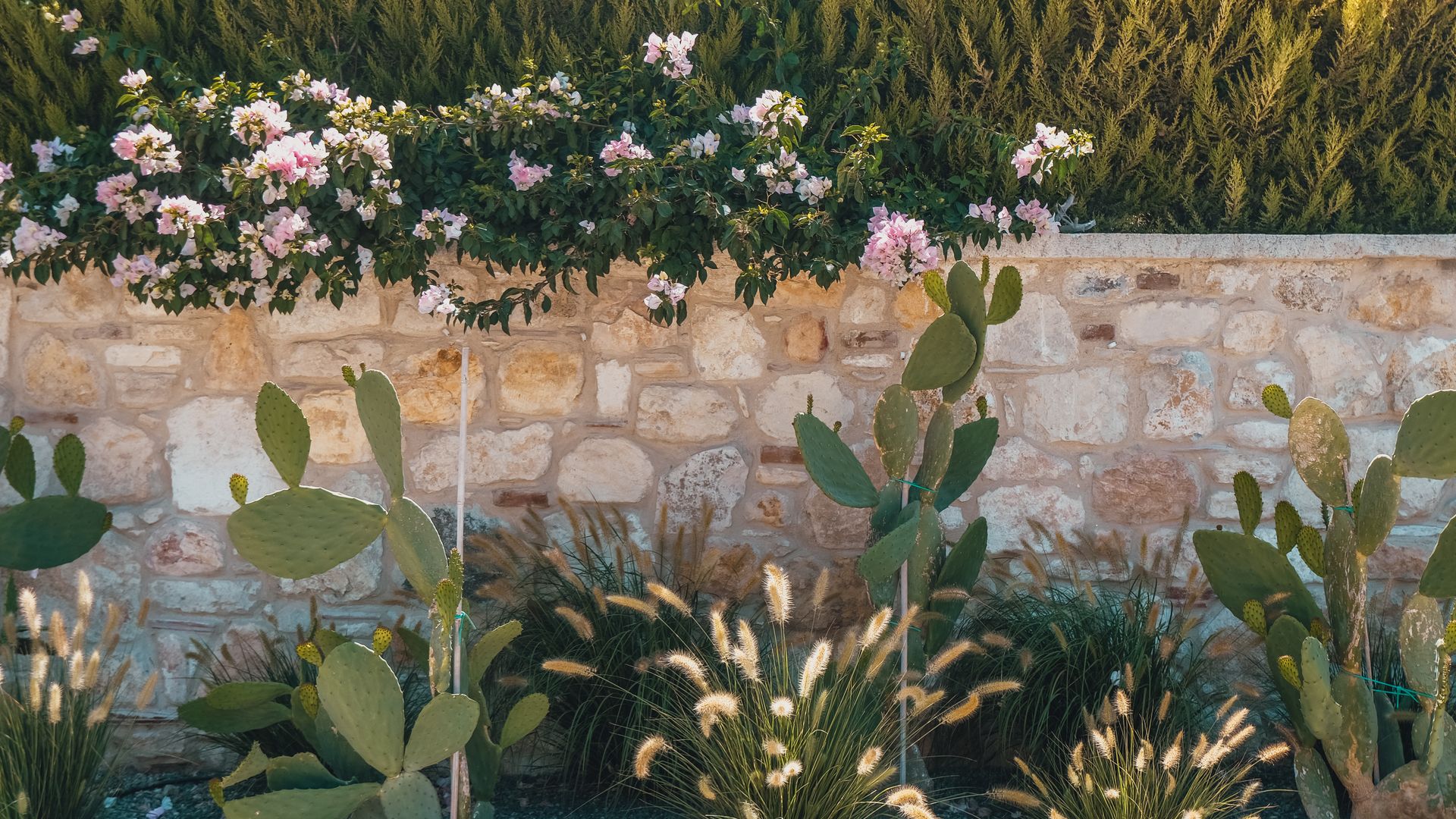
A scheme of olive, carob, lavender, rosemary, oleander and bougainvillea establishes on far less water than a scheme built around thirsty imports, and it looks appropriate rather than transplanted. Plant size at delivery then multiplies everything: a mature specimen tree costs a large multiple of the same species in a small pot, and it also brings a crane or a telehandler onto the job, which brings access back into the conversation.
Access
Everything in a garden arrives by vehicle and leaves by vehicle. Where the approach is steep or narrow — the hillside plots above Peyia are the standard example — delivery vehicle size is capped by the road, so the same tonnage of aggregate, soil and paving comes in more loads, and spoil goes out the same way. Access does not appear as a line item. It appears as a higher rate on every line item.
Cost by district
Larnaca sits close to the island median, and the district's newer detached housing stock means a high share of gardens are being built from scratch on plots that are already level. That is the lowest-cost starting position. Around Oroklini, proximity to the salt lake raises humidity, which shifts plant selection and matters for anything metal left outdoors.
Paphos splits by geography rather than by district. On the coastal frontage at Kato Paphos, salt-laden air is constant, so marine-grade fixings become standard on pergolas, railings and irrigation hardware, and salt-tolerant species earn their place. Inland and uphill, the cost driver is access instead. Polis Chrysochous carries an additional travel allowance on day rates simply because of its distance from the contractor base in Paphos, and that shows up on labour-heavy work such as planting and paving.
Limassol carries the most active construction market on the island for the same specification, and the district also asks a different question of landscapers. Rapid high-rise development has shifted a share of the work from gardens to roof terraces, podium planting and balconies, where the constraint is the waterproofing underneath. Planting over a habitable space needs a root barrier, a drainage layer and a warranty position agreed with whoever laid the membrane — a specification exercise before it is a gardening one.
Nicosia, being inland, has the widest temperature range on the island. Planting selected for a coastal microclimate will not necessarily hold through a Nicosia winter night or an August afternoon, and shade structures are a larger share of the budget there than they are on the coast.
Famagusta district is governed by the calendar. In Ayia Napa and the resort stock around it, external works are concentrated into November to March, because that is when the properties are empty. Conveniently, that is also the correct planting window in Cyprus, since roots need the cool half of the year to establish before the first summer tests them.
The district price pages hold the published ranges area by area, and the areas index shows which contractors actually travel where.
What is usually excluded
- Rubble and spoil removal. Excavating a terrace generates material that has to leave on a lorry to a licensed tip.
- Imported topsoil and compost. Priced by volume, and the volume is only known once levels are set.
- Irrigation controller and connection. The pipework is often quoted while the controller, valves, filter and the connection to a supply are not.
- A separate garden water supply. Where the intention is to irrigate from a borehole or a stored tank rather than the mains, the supply side is a different trade and a different licence.
- Garden lighting. Cabling, transformers and the electrical certificate belong to an electrician, not to a landscaper.
- Drainage and soakaways. Cyprus rain arrives all at once or not at all, and a terrace without a fall and an outlet becomes a pool in January.
- Structural design. Retaining and boundary walls above a modest height need calculations and, in most cases, permission.
- Establishment care. Somebody has to water, feed and replace losses through the first summer. Where that is not written into the quote, it is not included.
- VAT treatment. Whether the total is inclusive changes the comparison between two otherwise identical offers.
How to compare quotes
Landscaping is the trade where identical-looking quotes diverge most, because there is no standard scope. Impose one. A measured plan with areas marked, handed to every contractor, turns guesses into comparable prices. Ask each quote to state:
- Hard landscaping by area, with the build-up written out: sub-base, membrane, bedding layer, paving type and finish, edge restraint.
- Earthworks by volume: what is excavated, what leaves site, what is imported.
- Retaining walls by height and length, and who is providing the structural design.
- A planting schedule listing species, pot size and quantity, rather than a lump sum for planting.
- Irrigation by zone, naming emitter type, pipe runs, filtration and the controller.
- Turf or artificial turf as a separate area figure, with the sub-base for each.
- Who waters and maintains until the planting is established, and for how long.
- What is guaranteed, and specifically whether plant losses are replaced.
Quotes that answer all of that can be compared on the bottom line. Quotes that do not are describing different gardens. The landscaping price guide and the services index on this site set out the same fields, and the calculator gives a starting range once the treated area and the slope are known.
Common questions
Is a lawn realistic in a Cypriot garden?
It is possible and it is the most water-hungry decision available. A lawn needs irrigation through the whole summer, so the honest comparison is not the installation price but the installation price plus years of water. Artificial turf removes the water and the mowing, costs more to install than seeding, and gets uncomfortably hot in direct August sun, which is why it works better in shaded courtyards than in open gardens. A gravel and planting scheme sidesteps both problems.
When should planting be done?
In the cool half of the year, so roots establish before summer. Planting into early summer heat means either losses or an irrigation regime doing work the weather should have done. Contractors know this, which is why their planting books fill from autumn onwards and paving work dominates their summer.
Does a garden wall need permission?
A low decorative edging does not. A boundary wall or a retaining structure is another matter: retaining walls and boundary structures fall under building permit control, and they are dealt with by the Department of Town Planning and Housing through the relevant municipality. On a sloping plot this is worth establishing before design work starts, because the permit governs the layout rather than following it.
How much maintenance does a Cypriot garden need?
Less than a northern European one if it is planted for the climate, more than nothing under any circumstances. Irrigation needs seasonal adjustment and annual checking for blocked emitters, and drought-tolerant planting still needs pruning. Most landscapers offer a maintenance visit schedule, and it is worth pricing alongside the build rather than after it.
Why do landscaping quotes vary so much?
Because the ground is unknown until somebody digs, and because there is no standard scope in this trade. The ranges here show where a figure sits against other quotes in the same market. They do not say what a particular garden should cost, and no range can, until levels and soil are established on site.
Landscaping contractors in Cyprus
8 companies shown here.
New Roots Nursery
Peyia, Paphos
New Roots Nursery is a garden centre in Peyia, in the Paphos district.
- Landscaping
- Florists
K. Neophytou
Germasogeia, Limassol
K. Neophytou is a garden centre in Germasogeia, in the Limassol district.
- Landscaping
- Florists
Green Garden
Kolossi, Limassol
Green Garden is a garden centre in Kolossi, in the Limassol district.
- Landscaping
- Florists
Green Valley
Larnaca Centre, Larnaca
Green Valley is a garden centre in Larnaca Centre, in the Larnaca district.
- Landscaping
- Florists
Livadia Gardens
Livadia, Larnaca
Livadia Gardens is a garden centre in Livadia, in the Larnaca district.
- Landscaping
- Florists
Ma.Ra. Gerddenita
Nicosia Centre, Nicosia
Ma.Ra. Gerddenita is a garden centre in Nicosia Centre, in the Nicosia district.
- Landscaping
- Florists
Mary Ann
Aradippou, Larnaca
Mary Ann is a garden centre in Aradippou, in the Larnaca district.
- Landscaping
- Florists
N&K Garden Centre
Larnaca Centre, Larnaca
N&K Garden Centre is a garden centre in Larnaca Centre, in the Larnaca district.
- Landscaping
- Florists
Sources
- Department of Town Planning and Housing — retrieved 2026-07-28
- Cyprus Scientific and Technical Chamber (ETEK) — retrieved 2026-07-28
- Cyprus Statistical Service — construction cost indices — retrieved 2026-07-28

Where to go next
Companies, districts and the rest of the guides on this subject.

Thinking of doing this?Get up to five quotes, free.
Send us the job and we will gather quotes against the same written scope, so the numbers are comparable.